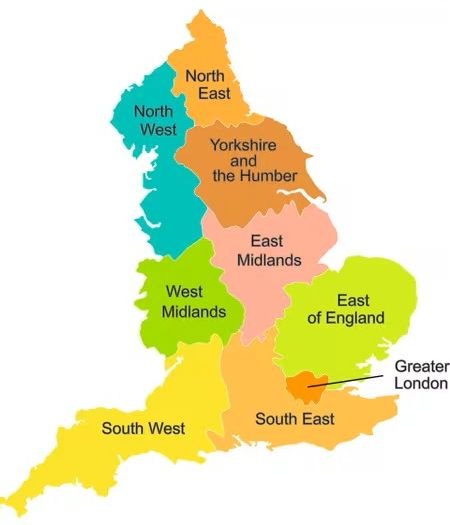
England is divided into nine official government regions used for statistical and administrative purposes: London, South East, South West, East of England, West Midlands, East Midlands, Yorkshire and the Humber, North West, and North East.
These regions often have distinct economic, cultural, and geographical characteristics, ranging from industrial northern areas to agricultural and coastal southern regions.
The Nine Regions of England
London: The capital and largest city, serving as the country’s economic and political hub.
South East: Encircles London, featuring historic towns and high-tech industries.
South West: Known for its coastline, tourism, and rural landscape.
East of England: Known for agriculture and high-technology industries.
West Midlands: A historic industrial region including Birmingham.
East Midlands: A mix of manufacturing and agricultural land.
Yorkshire and the Humber: Known for its industrial heritage, specifically textiles and steel.
North West: Contains major cities like Manchester and Liverpool, as well as the Lake District.
North East: Known for its industrial history and the Newcastle/Gateshead area.
These regions (also known as NUTS level 1 or ITL 1 regions) were officially adopted in 1994 and are commonly used for reporting, such as in GDP statistics.
Leave a Reply